
Hands—A Landscape
Hands map a path to connection—with self, others, and the world.

On hearing again the poem A Ritual to Read to Each Other, by William Stafford, I was once again deeply moved. (I cannot post the entire poem here so urge you to read it as a whole.) Has there ever been a time when “the darkness around us is deep” was not the case? This poem is necessary. I reread it the next day, then another poem, and another. Each was revelatory!
Sometimes I read Stafford’s work and think merely, “That was a nice poem.” It’s a sure sign I’m not in touch. With the world, with people I care about, with my own soul.
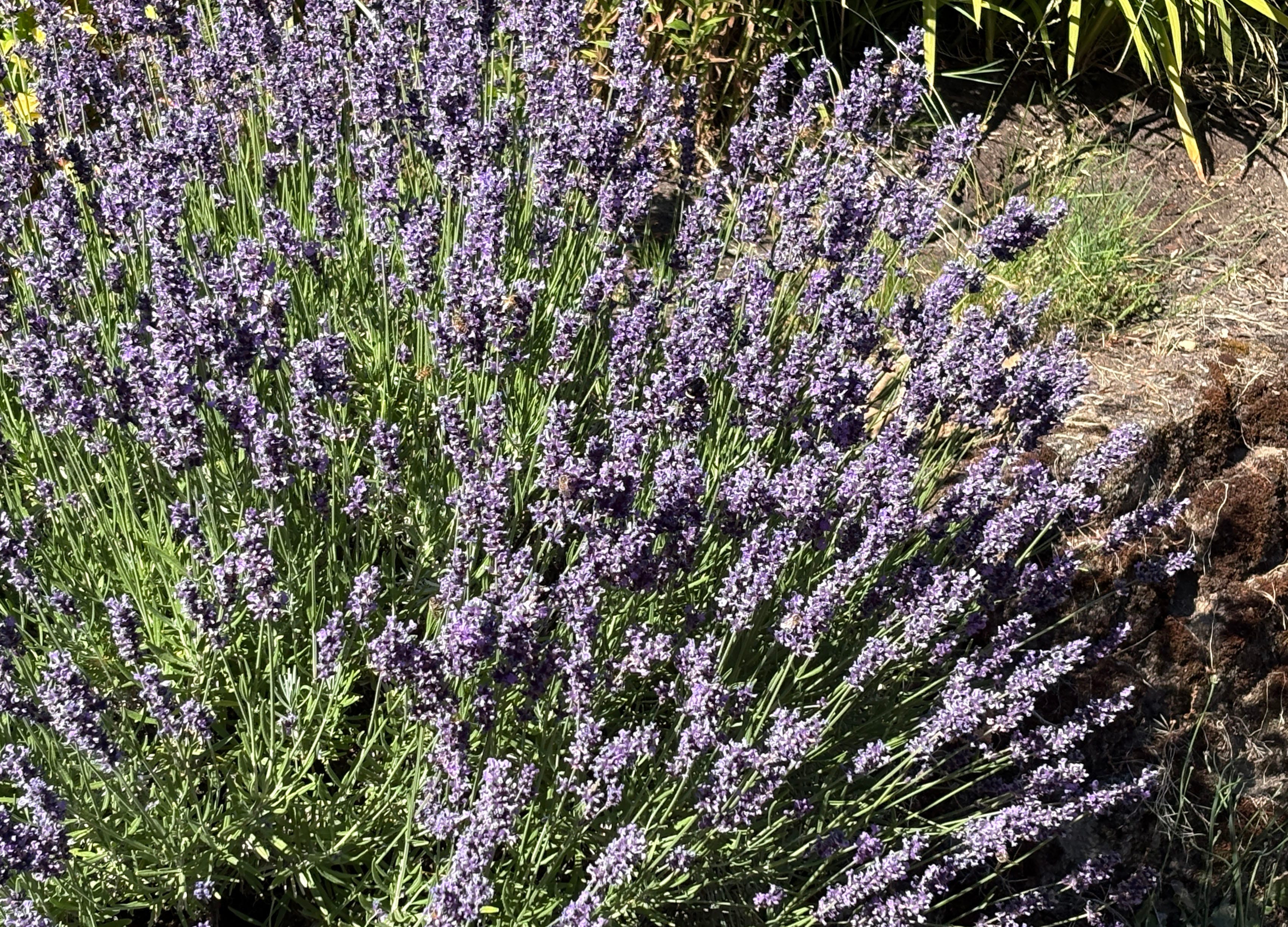
Poetry speaks to a place inside us that, when its door is open, a wind carrying clove and lavender, love and pain, longing and beauty can blow through. In and out, a breathing. We might tingle, even as another of its cargoes, deep and weighty, winds along the ground, anchoring the rising tingles with a pull down into roots.
The poem “Next Time”1 begins with a resolve first to watch and listen better to the earth, the wind, and the person speaking, and only then to say anything in reply. He concludes:
     "And for all, I’d know more—the earth
     bracing itself and soaring, the air
     finding every leaf and feather over
     forest and water, and for every person
     the body glowing inside the clothes
        like a light."
For every person he would know that light. How powerful a pause, a watch and listen.
Then I found “Turn Over Your Hand.”2 The poem begins by meditating on the tiny messages held in the lines on your palm, including one about trying to be someone other than you are.
     "…and only this fine record you examine
     sometimes like this can remember where
     you were going before that long
     silent evasion that your life became."
Reading these poems back-to-back was like a peanut butter and jelly sandwich of poems. Each brings something to the other; together they make a whole new thing.
The silent evasion of my life—can my hand really hold a memory of where I was going before that started?
Chronic pain, grief, microaggressions or depression or loneliness or other difficulties one may live with invite evasion—of that pain, the body that carries it, the self one might hold responsible. Evasion is a trail leading away. Under a starless sky.
Together, these poems suggested to me that the light found when pausing, so as to truly see the body—others’ and my own—that is “glowing inside the clothes” might show path back to a truer self.
At the same time, the poems resonated with a unique experience I’d had earlier that week, during an acupuncture session. My hands hosted many needles, evidence of their many connections to the rest of my body. Lying in the dimmed and quiet room, I felt a sort of wiggling in my arms—not a twitch or a tingle or anything else I’d ever felt before, but sinuous movement, as though something sluggish were activating, awakening. A slow muddy creek beginning to run clear.
Maybe those connections are why you can read in the landscape of a person’s hands a map to the terrain of their life. How the hands move, touch a thing, their callouses, knobs, and yes, their lines. What they’ve experienced, spent time on, overcome.
Hands are, to me, a bit magical. I once heard on the car radio a song about hands that made me pull over and just listen. It turned out to be Simply Red singing the Bill Withers beauty,“Grandma’s Hands.” Either somebody’d been inside my brain, or I wasn’t the only one under the spell of hands.
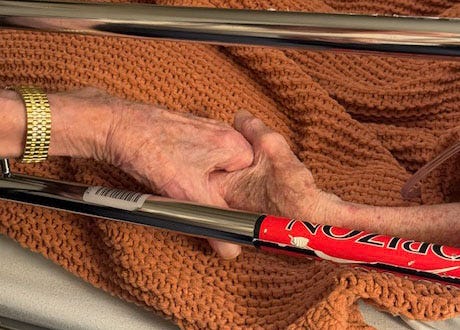
Which brings me to a special pair of hands. This month held what would have been my mother’s 94th birthday, and the second time I couldn’t keep her tradition of picking up the phone and singing “Happy Birthday.” Jetta Mae Pitts Lenox did love being a grandma—not to mention a great-grandma. As I sat down to write a eulogy for her service, Mom’s—Grandma’s—hands were what I saw:
I am writing this by hand, Mom, because when I think of you, I see your hands. Busy. Handing over a glass of iced tea, or reaching in for a hug. Fixing another batch of your yummy cookies. Cleaning up the mess afterwards.
Your hands feeding fabric under the presser foot of your sewing machine, making our clothes, making curtains for whatever house we’d just moved to. Sewing Halloween costumes for the kids. Spanking us. Washing us. Stripping wallpaper in my house to make a pretty guest room that would also be my writing space.
No task was too big or too unfamiliar. Not even applying plaster to patch a big hole in my curved ceiling—a job I couldn’t find a contractor to do. You were a do-er. You’d come to visit and just get busy.
Working as a nurse part-time and volunteering in the school clinic on top of that (clever way to keep an eye on us). Serving the annual Christmas tea at your church, which you dreamed up and pulled off, year after year.
Your hands holding books—you were a reader and a reading coach at whatever elementary school was nearby. And not just after you retired, either. I remember you coming in to read with a kid in my class when I was in sixth grade. I also remember your heartbreak decades later, after a child you were reading with moved to a different school, and they wouldn’t tell you where. Wouldn’t let you keep working with him. Not many people got away with saying No to you.
Your hands on a steering wheel, driving us here, there, back & forth. Piano lessons, swim team, orthodontists. Driving us across the country on another move. Driving me for my first job, at age 14, delivering the Pennysaver. I got in and out of the car on every block, but you did all the rest. I wonder now if I even made enough to cover the gas you bought.
Your healing hands—whether little boo-boos or cleaning a gash before we headed to the emergency room.
Your love and service were practical. You blessed so many of us. Including those who never knew that the thing that made such a difference in their life was done by your hands.
This excerpt is so much less than the whole poem. You can read it all in the Friends of William Stafford newsletter, on page 11.
William Stafford, The Way It Is (Graywolf Press, 1998), p. 224.